At Cana Primary School, the curriculum is designed to ensure that all students gain the knowledge, skills and deep understandings required for success in 21st Century society. Children are exposed to a broad range of learning experiences.
Knowledge, skills and understandings in Literacy and Numeracy are central to overcoming social and economic disadvantage and providing the skills to participate fully in democratic society. It is therefore critical that each student has every opportunity to learn to become fully literate and numerate.
At Cana, we are committed to delivering a high-quality education grounded in evidence-based research and aligned with the Victorian Curriculum 2.0 and the MACS Vision for Instruction and Vision for Engagement.
We use systematic, explicit teaching to ensure all students master essential knowledge and skills. Teachers clearly model new learning, provide guided practice, and support students to apply their understanding independently. This approach builds accuracy, confidence, and deep conceptual understanding.
We maintain high expectations for every learner, while providing the support and challenge needed for success. Learning is carefully sequenced so that students can progressively build knowledge and skills over time.
Students also engage in problem-solving and application tasks that require them to transfer their learning to new and meaningful contexts.
Our approach is designed to develop confident, capable learners who can think deeply, communicate effectively, and apply their knowledge in the real world. We combine academic rigour with a supportive learning environment where high expectations are matched by high levels of care.
English
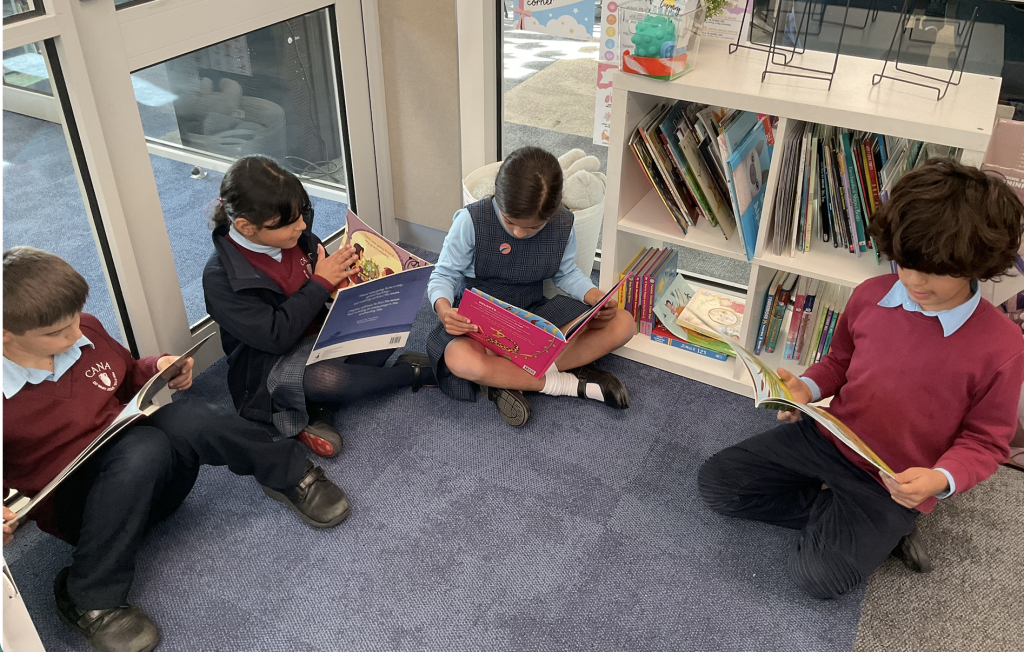
At Cana, our English programs align with the Victorian Curriculum 2.0 and are delivered through consistent, evidence-based practices. In our foundational years, we deliver a systematic and evidence-based reading program informed by the Science of Reading. Our students participate in a systematic, evidence-based, whole-class literacy program (Foundation to Year 2) rooted in cognitive science. It explicitly teaches the five essential components of reading; phonemic awareness, phonics, fluency, vocabulary, and comprehension, using synthetic phonics and decodable readers to build strong decoding skills.
Our middle and senior school programs (Year 3 to Year 6) use structured curriculum resources that focus on how students learn to read and write. Core components in our literacy program include reading, spelling, grammar, handwriting, reading fluency, sentence-level writing, text-level writing, and vocabulary sessions. Our students apply their literacy skills by critically analysing complex structures and expanding their vocabulary to unlock deeper meaning in challenging texts. By learning to look beyond the literal surface, they evaluate perspectives and connect ideas, ensuring they can confidently navigate and interpret information in the real world.
We equip our students with the practical literacy skills they need to navigate, understand, and communicate confidently in everyday life.
Mathematics
We are committed to developing confident and capable mathematical thinkers at Cana. Our mathematics program is based on the Victorian Curriculum 2.0 and delivered through a consistent, evidence-based approach.
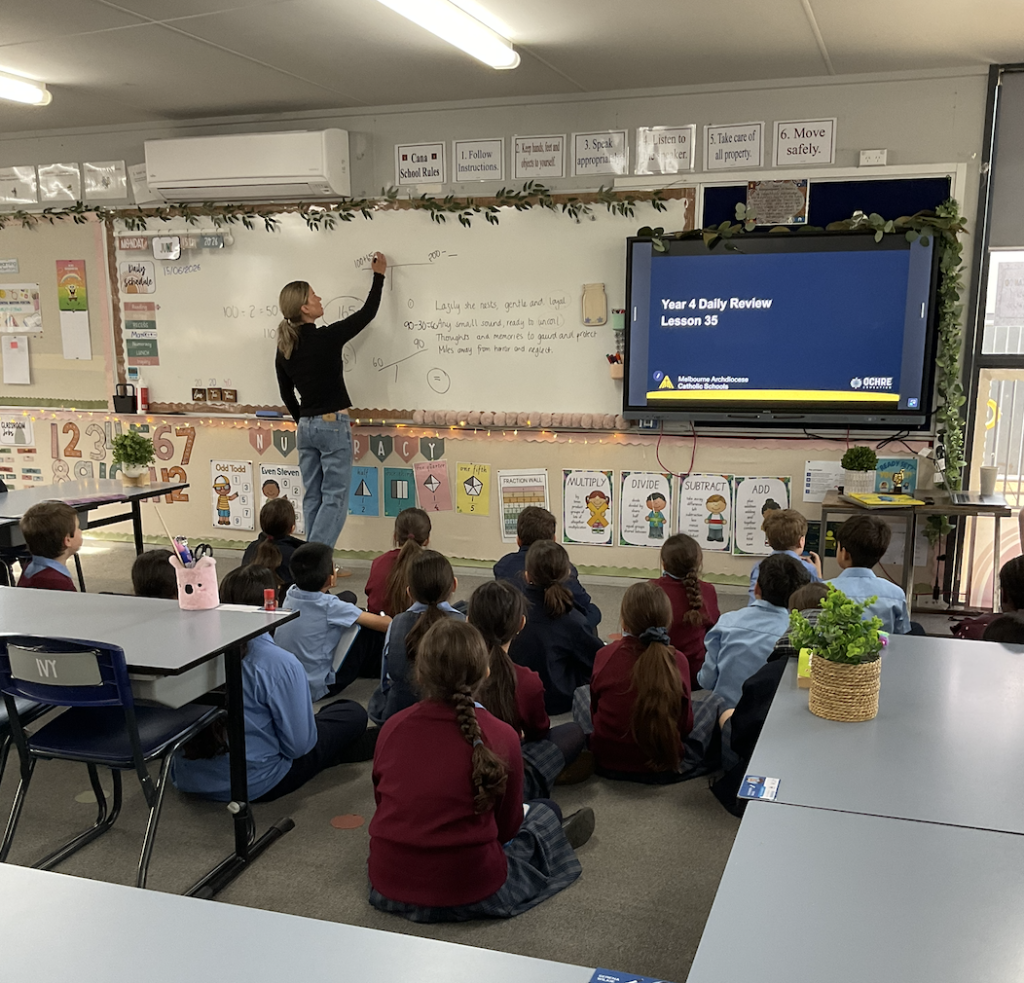
Mathematics is taught using an explicit instruction model following the structure of I Do, We Do, You Do. Teachers explicitly model new learning, guide students through structured practice, and provide opportunities for independent application. A strong emphasis is placed on guided practice to build accuracy, confidence and deep understanding.
Our approach focuses on developing strong number sense, fluency and conceptual understanding through clear and systematic teaching. Concrete materials support students in moving from hands-on learning to representational and abstract thinking. Problem-solving strategies and precise mathematical language are explicitly taught to support reasoning and communication.
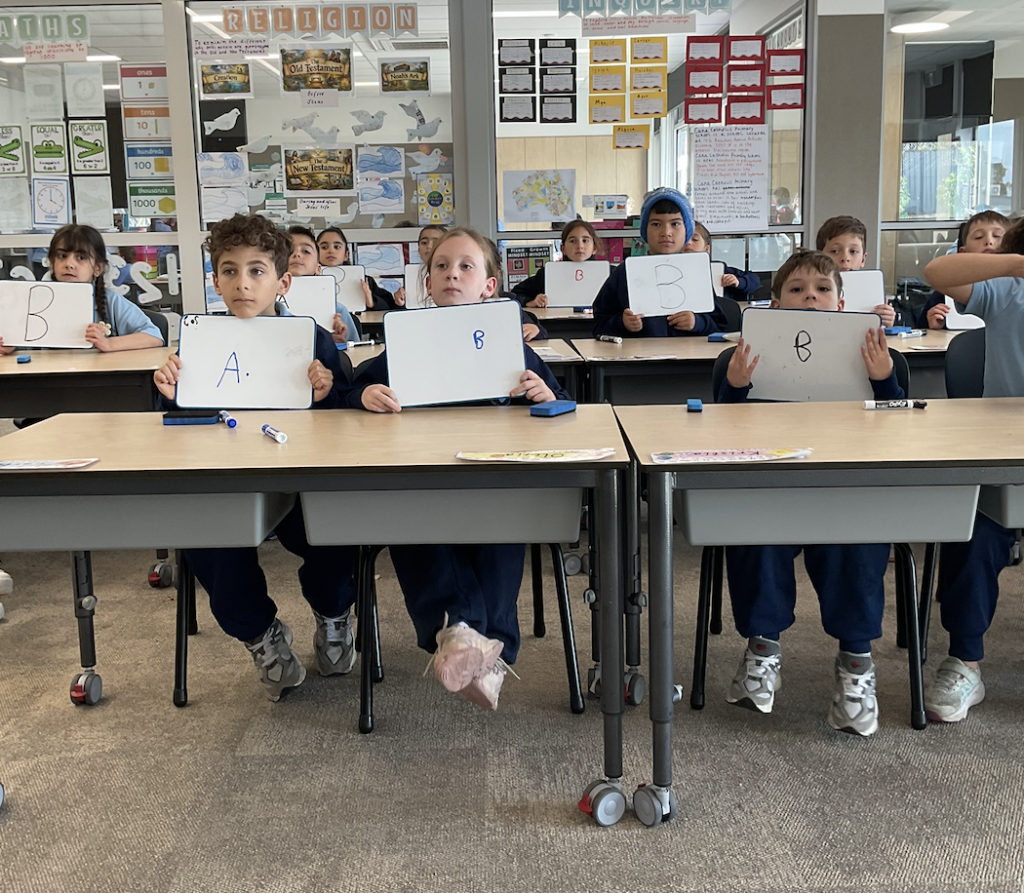
Teachers use ongoing formative assessment and regular checks for understanding to inform teaching. Support may include additional scaffolding or guided practice, while extension opportunities provide challenge through deeper application of skills and concepts.
Students also participate in the Maths Acceleration Program (MAP), a daily 10-minute session focused on building mental computation strategies and fluency. MAP follows a whole-school developmental continuum and uses explicit teaching and concrete materials to develop number sense, flexibility and efficient thinking.
Capabilities
The four capabilities – Critical and Creative Thinking, Ethical, Intercultural, and Personal and Social—are sets of knowledge and skills that are explicitly developed and applied in and through learning across the school.
They are taught alongside curriculum content so students can apply their knowledge in meaningful ways, building the thinking, reasoning, and social skills needed for learning and life.
Teachers integrate these capabilities into learning tasks, providing opportunities for students to question, reason, collaborate, and reflect.
Through this approach, students develop the capacity to think critically, act ethically, and engage respectfully and independently in a range of contexts.
Humanities and Social Sciences (HASS)
Our HASS program is aligned with the Victorian Curriculum 2.0 and provides students with rich opportunities to develop their understanding of history, geography, civics and citizenship, and economics and business.
Students engage with significant people, places, events and issues, exploring questions about the world around them and developing an understanding of how societies, environments and communities have changed over time. They learn to make connections, consider different perspectives, and apply their knowledge in meaningful contexts.
Through our HASS program, students are provided with opportunities to explore the rich diversity of Australia, including Aboriginal and Torres Strait Islander histories and cultures, fostering respect, understanding and active citizenship.
Information and CommunicationTechnology (ICT) at Cana
At Cana, we believe that children growing up in a 21st Century society should be exposed to the use of technology. We have a 1:1 program for students in Grade 3-6, where each student has their own Chromebook. Students in Prep-Grade 2, also have shared iPads.
Through active participation in the curriculum, we endeavour that students become active and informed citizens, confident and creative individuals and most importantly successful learners.
ASSESSMENT AND REPORTING
At Cana Primary School assessment and reporting is an important part of learning and teaching. Teachers use a variety of assessment tools to inform their planning, to better understand the learning needs of their students and to monitor student achievements and successes.
Assessment and Reporting is offered in a number of ways at Cana. These include:
- Introductory Interviews held at the beginning of each school year.
- Written reports sent home twice per year (Term 2 and Term 4).
- Two parent teacher interviews held in Term 2 and Term 3.
- Parents will receive a copy of the report generated as a result of participation in National Testing (NAPLAN). This is for parents with children in Grade 3 and 5.
- Ongoing conversations with staff as required.